
Polished needles vs. textured needles
10. Polished Needles vs. Textured Needles

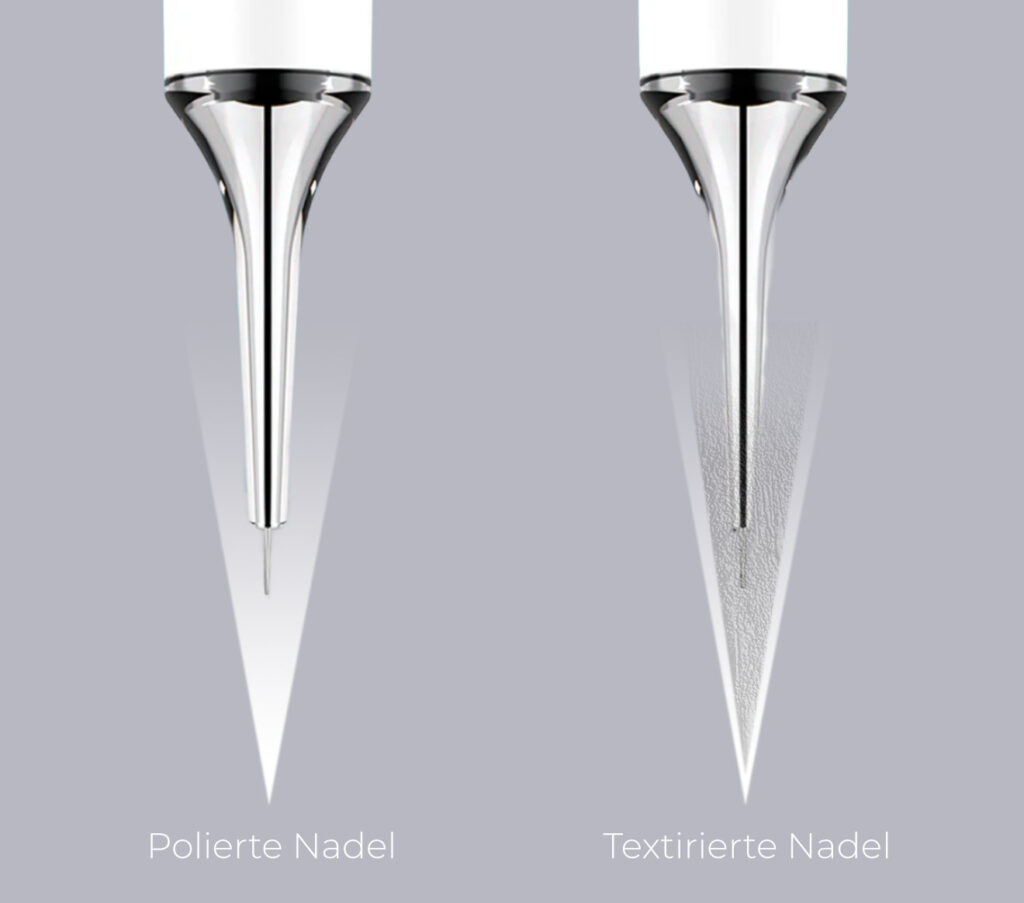
10.1. Polished Needles
Surface:
Polished needles have a smooth, shiny surface. These needles are finished through polishing, which gives them a mirror-like surface.
Friction:
Thanks to their smooth surface, these needles glide more easily through the skin, which minimizes friction and makes the procedure more comfortable for the client.
Color image:
Because of their smooth surface, polished needles absorb less dye than textured needles. The dye tends to remain on the outside of the needle.
Cleaning:
Polished needles are easier to clean and disinfect because there are no microscopic irregularities where pigments or residues could become trapped.
10.2. Uses of Polished Needles
Fine lines and details:
Polished needles are ideal for precise work, such as drawing fine lines and small details. The smooth surface allows for precise control over the needle's movement.
Hygiene Applications:
Because they are easy to clean and disinfect, polished needles are well-suited for areas where hygiene is critical, such as permanent makeup on the eyebrows, lips, and eyelids.
10.3. Textured Needles
Surface:
Textured needles have a rough or textured surface. This texture is created through a special manufacturing process that intentionally roughens the surface of the needle.
Friction:
The rough surface creates more friction, which causes the needle to encounter more resistance as it penetrates the skin.
Color image:
Textured needles can hold more ink and deposit it into the skin. The rough surface features small indentations and grooves that can hold more pigment.
Color rendering:
These needles deposit more pigment into the skin during tattooing or permanent makeup, resulting in richer and more even color.
10.4. Uses of Textured Needles
Rich color fields:
Textured needles are ideal for filling large areas with paint, as they can hold and release more pigment. This is especially useful for shading and color packing.
Shades:
Their ability to hold more dye makes textured needles excellent for shading and color transitions. They produce more even and deeper shades than polished needles.
Large areas:
For tattoos that require large areas of color or intense shading, textured needles are the better choice because they distribute the color pigments more efficiently.
Summary
Polished needles:
- Surface: Smooth and glossy.
- Friction: Low; glides more easily over the skin.
- Paint coverage: Less paint.
- Intended Use: Fine lines, details, hygienic
- Applications.
Textured needles:
- Surface: Rough and textured.
- Friction: Higher, more resistance.
- Color Picker: More color.
- Intended Use: Rich color fields, shading, large areas.
By choosing between polished and textured needles, you can achieve the best results depending on the specific application and desired effect. Polished needles offer precision and cleanliness, while textured needles provide depth and color saturation.
