
All about lips

The lips are the focal point of every person's face. They are not only used to produce sounds, but are also an important element of facial expression.
Because the skin on the lips is very thin, the blood vessels show through, giving the lips their red color. However, this red color varies from person to person. Especially in people with fair skin, there are few pigment cells in the skin of the lips, which is why the underlying blood vessels show through more clearly than in the rest of the facial skin. In people with darker skin tones, there is a higher concentration of melanin (a natural pigment) in the skin of the lips, which makes the red color of the blood vessels less prominent.
The skin on the lips has no hair and lacks sweat and sebaceous glands. As a result, it does not produce the hydrolipid film that keeps the rest of the skin supple, so it becomes chapped and dries out more quickly.
When working on the skin of the lips, pigmentation behaves differently than on other areas of the face (such as the eyelids or eyebrows). The skin of the lips consists of a multilayered, keratinized squamous epithelium that has significantly fewer layers than the skin on the rest of the face. The closer you get to the mucous membrane, the less pigment can be absorbed, because there are fewer and fewer layers of skin. The closer you get to the superficial skin, the more pigment is absorbed.
If the initial pigmentation is too light, multiple touch-ups are often necessary to achieve the desired result. Therefore, take enough time to advise your clients on their color choice and explain the process in detail to alleviate their fears of overly intense results. This is because many clients want a very natural-looking result. However, instead of the overly intense result they feared, the pigmentation that remains after the healing process is often very subtle. This, in turn, can be disappointing for your clients. You should therefore collect before-and-after photos to help your clients understand the color loss that occurs during the healing phase.
People with fair skin naturally have lightly pigmented lip skin, which will show a more intense color result after treatment than people with darker skin who have naturally heavily pigmented lip skin. Since melanin is more visible in darker skin types, the pigmentation will result in a less intense color.


The lips
The lip is divided into the upper lip (labium superius) and the lower lip (labium inferius).
In the center of the upper lip is an indentation known as the Cupid's bow or lip heart. The vertical groove between the nose and the Cupid's bow is called the philtrum. It can be more or less pronounced.
The so-called "smile line" runs from the lower lip to the corners of the mouth and—apart from the Cupid's bow—is the most significant factor determining the shape of the lip.
It varies from person to person and can have more or less volume. In this context, more volume means rounder, while less volume means straighter.
When performing lip pigmentation, special attention should be paid to the Cupid's bow and the smile line to create the perfect lips.

The Ideal Lip Shape
Your client will want the perfect lips. Depending on the individual shape of the lips, there are various ways to enhance them with pigmentation. To ensure that you don’t alter your client’s appearance but rather highlight her best features, you’ll need a great deal of sensitivity and an eye for what really matters.
Lip shapes are as diverse and unique as fingerprints.
The same goes for beauty ideals and the tastes of our clients. With line work tailored to each individual’s features and the perfect color selection, we can achieve a flawless result for every natural lip shape. This ranges from natural lip pigmentation to a lipstick effect.
The preliminary sketch of the optimal lip shape should always be drawn on a relaxed lip (or one with only slight tension). When sketching the perfect lip, it should be as symmetrical as possible, harmonize with the face, and under no circumstances be painted over. (Enlarging the natural lip shape is only possible to a limited extent—a maximum of 1 to 1.5 mm. When sketching, always make sure to preserve the natural appearance of the lips and simply optimize them.)

Optimization of Various Lip Shapes
The Ideal Lip Shape/The Perfect Lips
A perfectly shaped lip has one-third of its volume in the upper lip and two-thirds in the lower lip. A flat to slightly curved cupid’s bow makes the lip appear fuller. An evenly rounded curve on both sides of the lip makes the lips look perfect.
Thin Lips
To enhance thin lips, they can be subtly outlined (by a maximum of 1 to 1.5 mm). However, it is important not to extend the outline so far that it looks unnatural. Certain shading techniques (e.g., the ombre lips technique) can add volume to narrow lips. If the client desires even more volume, this can be achieved through dermal fillers administered by a doctor. However, it is important that the pigmentation—including any follow-up treatments—be completed before such a procedure.

Full Lips
Full lips look sensual and represent the beauty ideal of our time. To achieve more fullness, people with other lip shapes often turn to lip fillers and contouring. If your lips are naturally full, you should avoid using extreme colors, as these can otherwise look overdone.

Wide mouth
For a wide mouth, the shape can be slightly corrected by visually ending the pigmentation just before the corner of the mouth. Avoid using colors that are too dark to achieve a natural-looking enhancement of the shape. The pigmentation along the outer line should fade off gradually. The cupid’s bows can be pigmented more distinctly to achieve an optimal shape.

Prominent upper lip
In such cases, the lower lip should be enhanced, but not exaggerated too much.
(The natural shape of the lips can only be enlarged to a certain extent—a maximum of 1 to 1.5 mm. When sketching the outline, always be sure to preserve the natural appearance of the lips and simply enhance them.)
If the difference between the upper and lower lips is too pronounced, a doctor can administer dermal fillers to help achieve a perfect result.

Prominent lower lip
The upper lip should be enhanced.
Explore your options with a preliminary sketch, and be careful not to over-sketch.
(The natural shape of the lips can only be enlarged to a certain extent—a maximum of 1 to 1.5 mm. When sketching the outline, always be sure to preserve the natural appearance of the lips and simply enhance them.)

Small Mouth
The lip contour can be pigmented here all the way to the corners of the mouth to create the appearance of wider lips. However, it is important that the corners of the mouth themselves are not pigmented (outlined).

Drooping corners of the mouth
When the corners of the mouth droop, it is especially important to optimize the shape. In this case, the lower lip should be perfectly contoured and shaded; with a perfect curve toward the corners of the mouth, it can create a positive effect and conceal the drooping corners. The upper lip should not be fully pigmented at the corners of the mouth and should have a subtle fade and subtle shading to help conceal them.
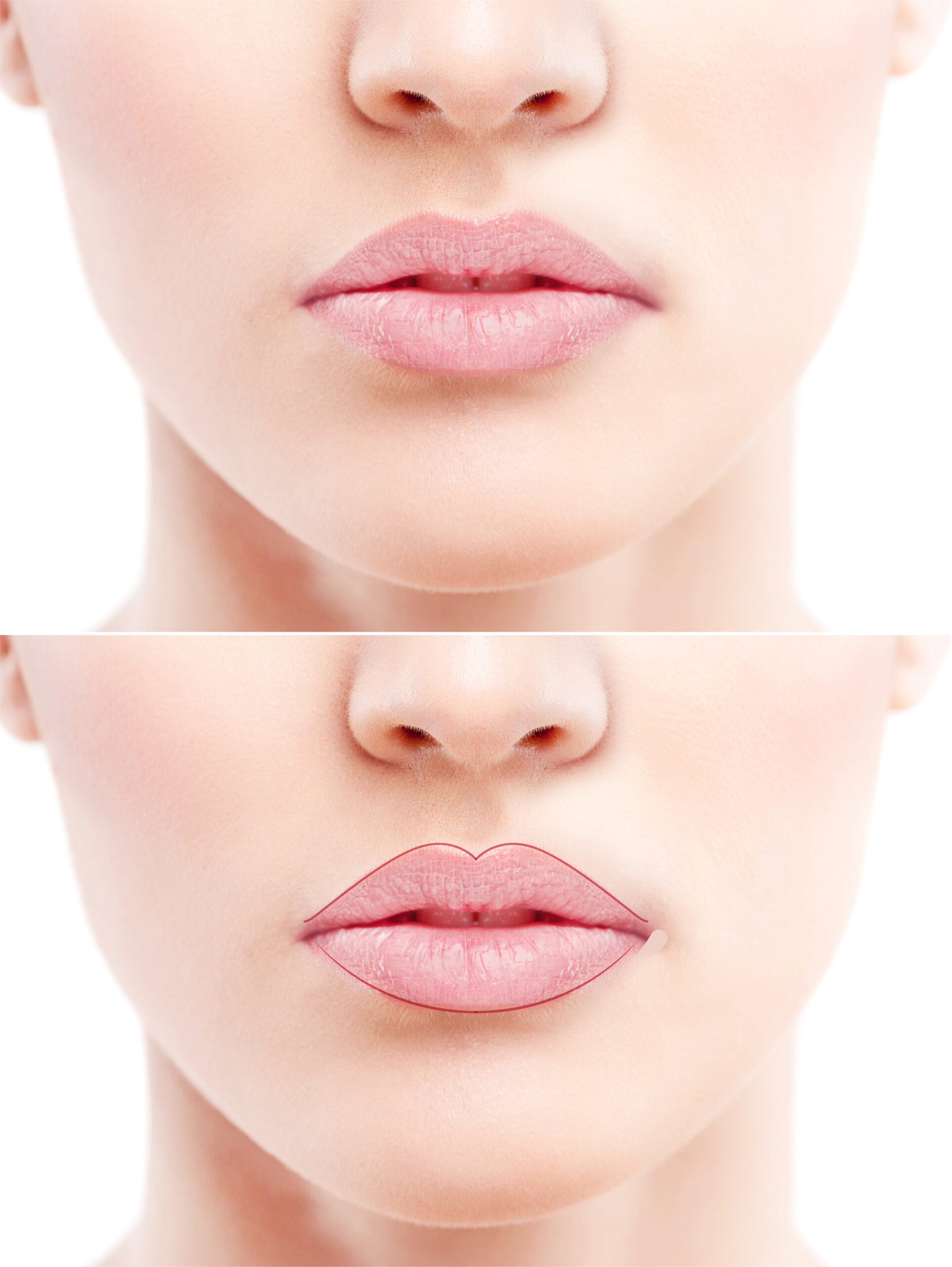
Optimal Pigmentation Technique for Anti-Aging Treatments
Over time, the lips lose their fullness because they retain less moisture. Fine lines also begin to form on the lips. As the lips become increasingly keratinized, their contour loses color and, consequently, definition. The keratinized part of the lip no longer allows the blood vessels to show through, which is why aged lips appear frayed, pale, and dull.
Lifting the Corners of the Mouth That Are Drooping or Appear Negative
When drawing a mouth that looks sad, skillful line work is most important. The main focus of the line work and shading must be on the rising portion of the contour. By creating an arc that is as positive as possible—one that ends before the corner of the mouth—a visually slimming effect can be achieved. The negative effect should also be optimized on the upper lip.
The volume is accentuated toward the slightly shortened corner of the mouth, and the sloping, unflattering part is not fully pigmented but rather tapers off subtly and is shaded more gently. Use fresh colors that are not too strong or too dark.

Copyright © 2017 by Pimp Your Skills GmbH
The copyright for the entire content (text, images and video material) is held by Pimp Your Skills GmbH (unless otherwise stated). The content may not be published, partially published, modified or reproduced without the consent of Pimp Your Skills GmbH.