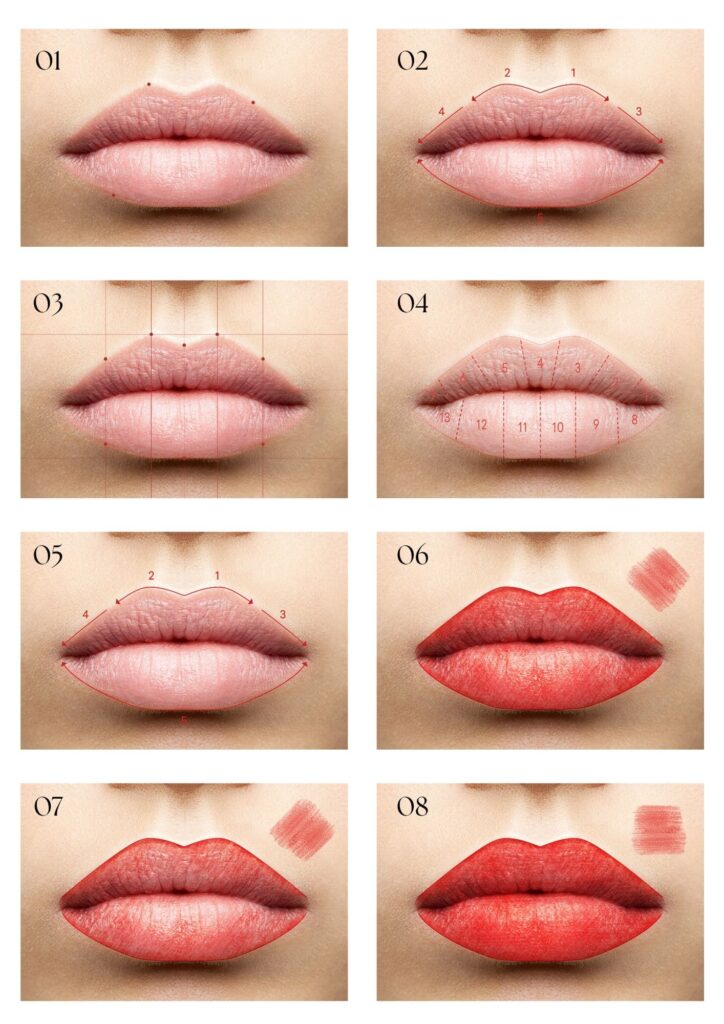
Lip Stick
Lip stick technique
The lip stick technique
Experience the intensity and extravagance of the lip stick technique. This method is characterized by its intense colour and eye-catching make-up effect. Not only is it easy to perform, it is also particularly gentle, resulting in rapid healing. Your customers will love the luxurious and long-lasting look.

- Analysis of the form:
First analyze the shape of the lips. - Marking of asymmetrical areas:
Mark asymmetrical areas of the lip shape with dots or strokes outside the lips to facilitate and even out the later sketching. - Optimal customer position:
It is best to mark the asymmetrical areas when your client is in a seated and relaxed position. Ask them to close their eyes to avoid facial expressions.
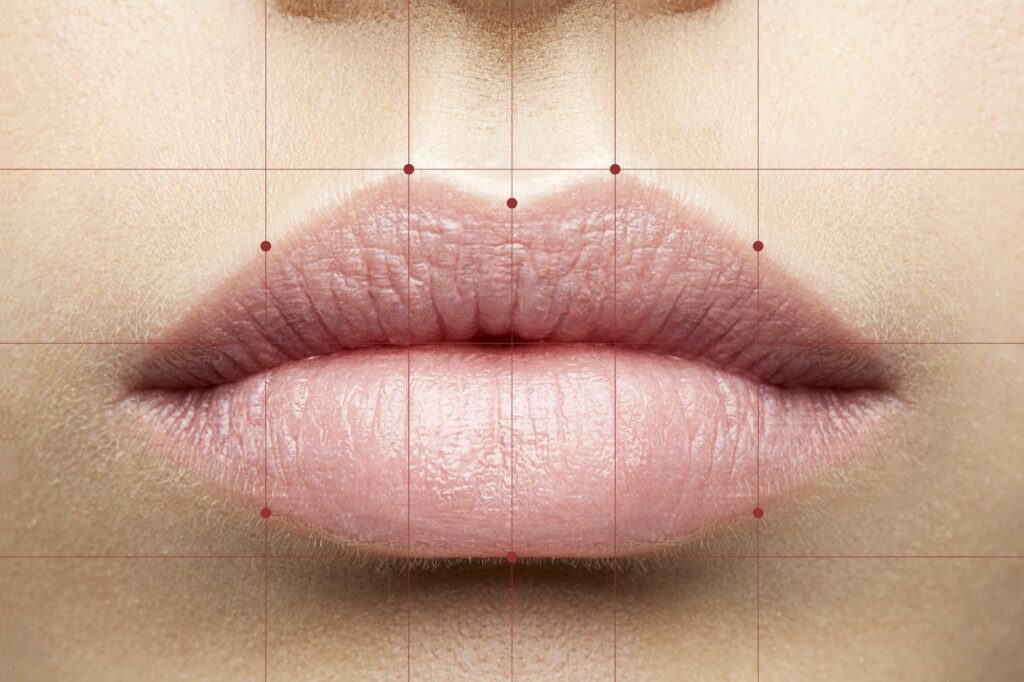
Further markings for preliminary drawing:
Make the preliminary drawing easier for yourself with additional markings outside the lip shape.

The preliminary drawing:
- Start in the lip heart:
Start by drawing the outline of the heart of the lips. First draw both lip arches before connecting the outline up to the corners of the mouth. - Observe the natural shape:
Pay attention to a natural shape and avoid unnatural overdrawing. Stick to the natural lip line as far as possible. - Connect the lower lip:
Connect the outline of the lower lip from one corner of the mouth to the other. - Precise lines:
Draw precise lines with a well-sharpened pencil and smooth movements. - Skin fixation:
A slight fixation of the skin is sufficient to avoid mobility. - Check symmetry:
Check the symmetry of the preliminary drawing and correct if necessary. - Upright position:
Always check the symmetry with your client in an upright, relaxed position. - Fill in the interior:
Finally, fill in the inside of the lips to give your client an idea of the final result.
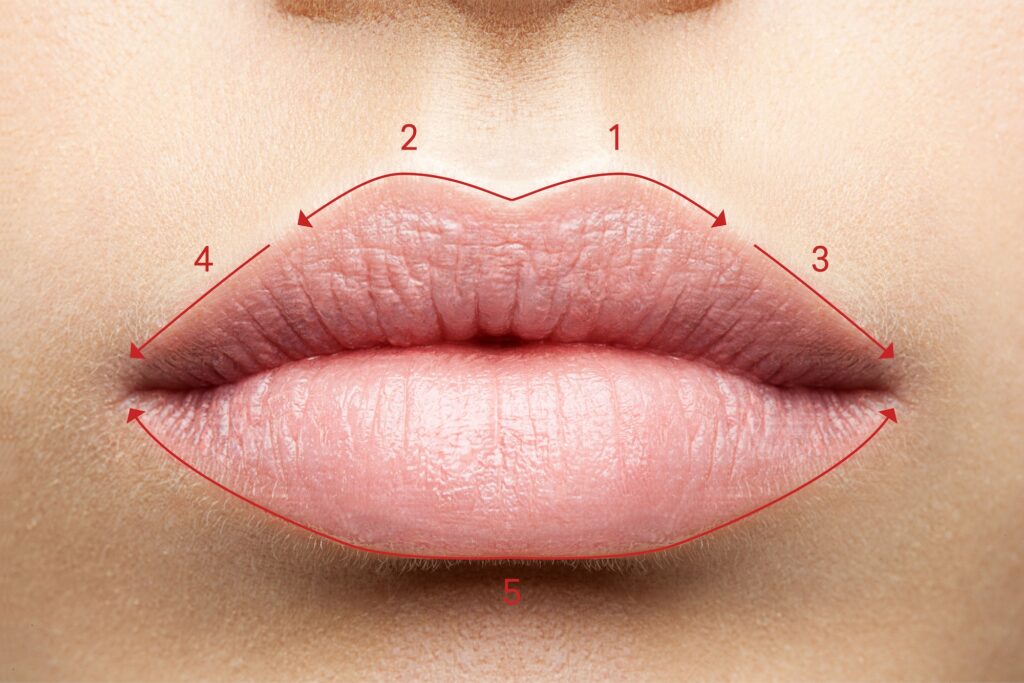
Pigmenting the outline:
- Start in the lip heart:
Start by pigmenting the outline in the heart of the lips. Pigment both lip arches first before connecting the outline up to the corners of the mouth. - Connect the lower lip:
Pigment the lower lip from one corner of the mouth to the other. - Intensity:
Depending on the desired intensity of the outline, pigmentation can be carried out in 1-3 passes. - Even tension and pressure:
Always ensure even tension, movements and gentle pressure. - Alternate halves:
Change the lip half after each pass. - Control breaks:
If necessary, take short breaks to check the color absorption and pigmentation.

The shading:
- Divide the lips into sections:
Divide the lips into individual sections of approx. 1-1.5 cm. You can do this visually or with line markings outside the lip shape. - Precise pigmentation:
Concentrate on small areas when shading in order to work precisely and effectively.
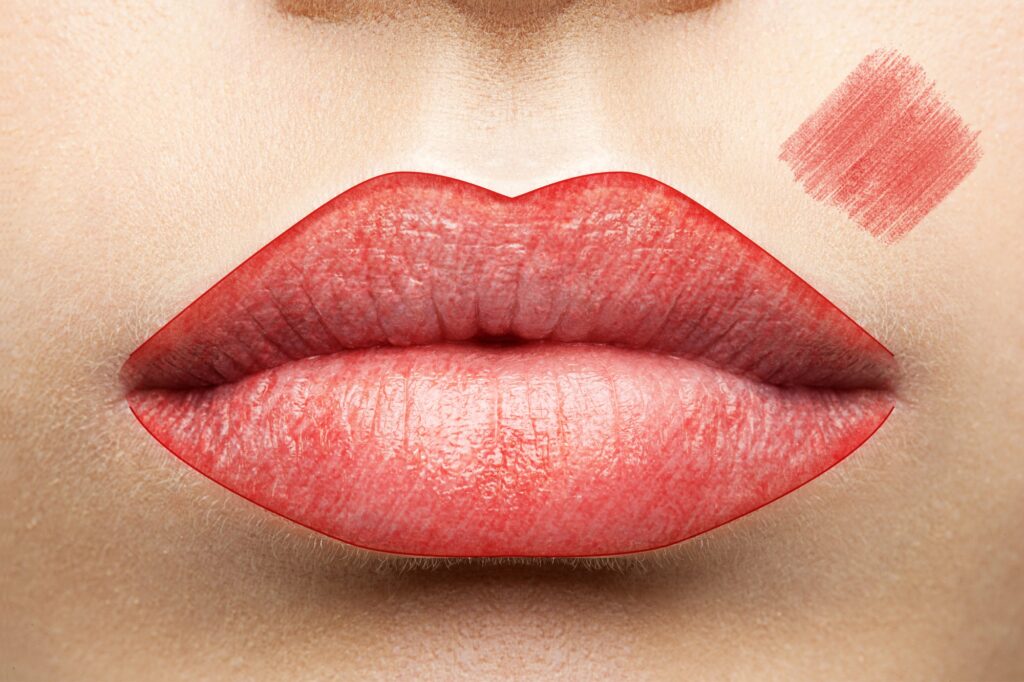
Shade step 1:
- Commuting in both directions:
Perform the first shading step at a slight angle with oscillating movements in both directions. - Dense shading:
Make sure to place the lines close together to achieve dense shading. - Smooth movements and gentle pressure:
Always ensure that the tension is well applied, the movements are regular and the pressure is even and gentle. - Section by section:
Always start at the corner of the mouth and work your way section by section to the opposite corner of the mouth. - One pass per section:
Perform shading step 1 with one pass per upper and lower lip. Depending on the skin texture, 2-4 times per section (1-1.5 cm).

Shade step 2:
- Similar technology:
Carry out the second shading step at a slight angle with oscillating movements in both directions. - Maintain tension and pressure:
Continue to pay attention to well-applied tension, regular movements and even, gentle pressure. - Change of direction:
The direction changes compared to step 1. - Upper lip first:
Pigment the upper lip first, section by section, before moving on to the lower lip. - Several passes:
Pigment 2-4 times per section. Cooling breaks can reduce irritation and increase color absorption. - Pigment booster cream:
Use the Pigment Booster Cream during breaks to soothe the skin and improve color absorption.

Shade step 3:
- Shade horizontally:
Perform the third shading step horizontally with oscillating movements in both directions. - Closely spaced movements:
Make sure that the movements swing evenly, are close together and are performed gently. - Upper lip first:
Again, start with the upper lip first and then work on the lower lip. - Several passes:
Pigment 2-4 times per section (1-1.5 cm). Depending on the desired intensity, step 3 can be repeated.